Featured Research

Tunable optical traps for levitating particles with metalens, Nanophotonics (2024)

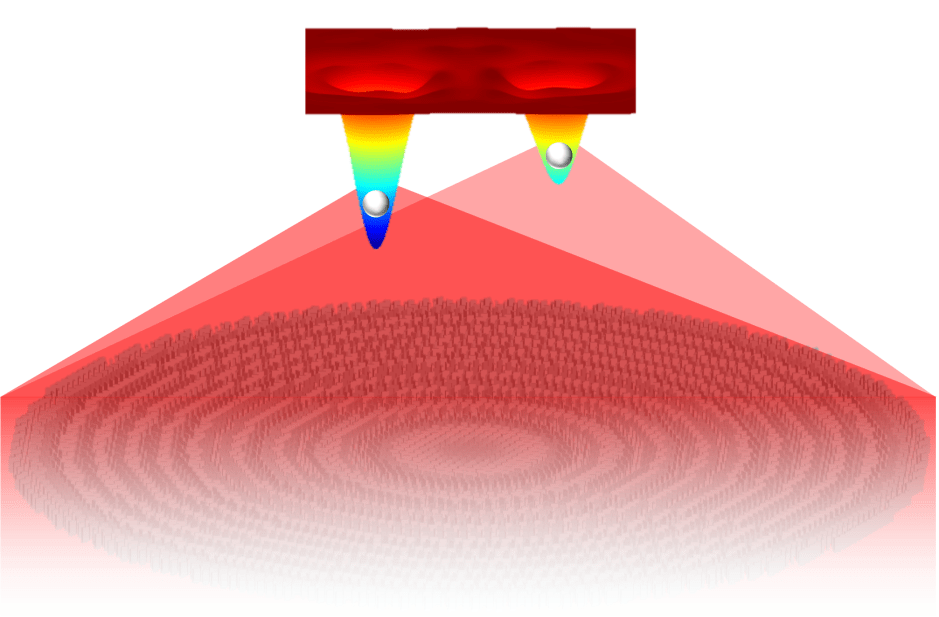
Optically levitated multiple nanoparticles have emerged as a platform for studying complex fundamental physics such as non-equilibrium phenomena, quantum entanglement, and light-matter interaction, which could be applied for sensing weak forces and torques with high sensitivity and accuracy. An optical trapping landscape of increased complexity is needed to engineer the interaction between levitated particles beyond the single harmonic trap. However, existing platforms based on spatial light modulators for studying interactions between levitated particles suffered from low efficiency, instability at focal points, the complexity of optical systems, and the scalability for sensing applications. Here, we experimentally demonstrated that a metasurface that forms two diffraction-limited focal points with a high numerical aperture (∼0.9) and high efficiency (31 %) can generate tunable optical potential wells without any intensity fluctuations. A bistable potential and double potential wells were observed in the experiment by varying the focal points’ distance, and two nanoparticles were levitated in double potential wells for hours, which could be used for investigating the levitated particles’ nonlinear dynamics, thermal dynamics, and optical binding. This would pave the way for scaling the number of levitated optomechanical devices or realizing paralleled levitated sensors.

Ref:
Tunable on-chip optical traps for levitating particles based on single-layer metasurface
C. Sun, H. Pi, K. S. Kiang, T. S. Georgescu, J. Y. Ou*, H. Ulbricht, J. Yan*
Nanophotonics (2024) published online DoI:10.1515/nanoph-2023-0873


Picophotonic localization metrology beyond thermal fluctuations Nature Materials(2023)

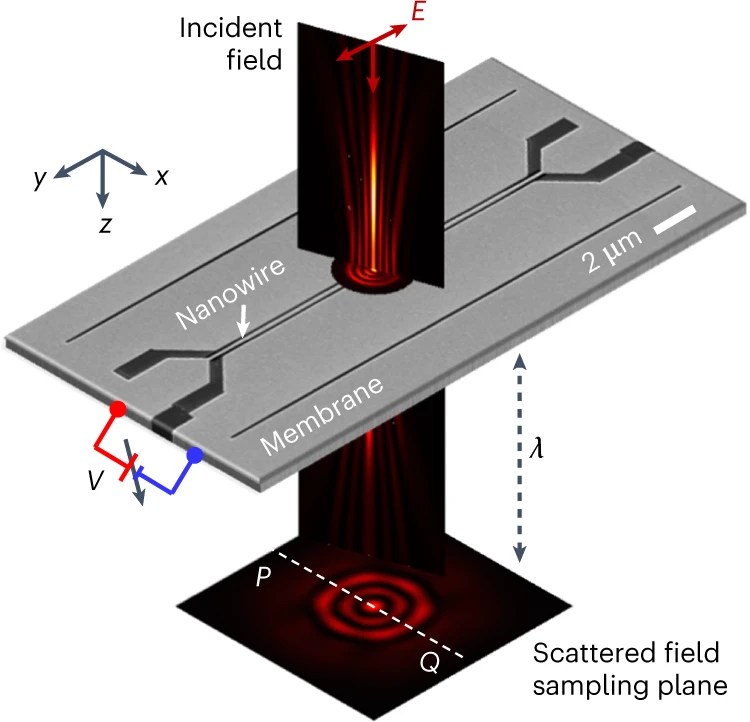
Despite recent tremendous progress in optical imaging and metrology, there remains a substantial resolution gap between atomic-scale transmission electron microscopy and optical techniques. Is optical imaging and metrology of nanostructures exhibiting Brownian motion possible with such resolution, beyond thermal fluctuations? Here we report on an experiment in which the average position of a nanowire with a thermal oscillation amplitude of ∼150 pm is resolved in single-shot measurements with subatomic precision of 92 pm, using light at a wavelength of λ = 488 nm, providing an example of such sub-Brownian metrology with ∼λ/5,300 precision. To localize the nanowire, we employ a deep-learning analysis of the scattering of topologically structured light, which is highly sensitive to the nanowire’s position. This non-invasive metrology with absolute errors down to a fraction of the typical size of an atom, opens a range of opportunities to study picometre-scale phenomena with light.

Picophotonic localization metrology beyond thermal fluctuations
T. Liu,C-H.Chi, J. Y. Ou,J.Xu,E.A. Chan,K. F. MacDonald and N. I. Zheludev
Nat. Mater. (2023) doi: 10.1038/s41563-023-01543-y

Photonic metamaterial analogue of a continuous time crystal Nature Physics (2023) 

Time crystals are an eagerly sought phase of matter with broken time-translation symmetry. Quantum time crystals with discretely broken time-translation symmetry have been demonstrated in trapped ions, atoms and spins whereas continuously broken time-translation symmetry has been observed in an atomic condensate inside an optical cavity. Here we report that a classical metamaterial nanostructure, a two-dimensional array of plasmonic metamolecules supported on flexible nanowires, can be driven to a state possessing all of the key features of a continuous time crystal: continuous coherent illumination by light resonant with the metamolecules’ plasmonic mode triggers a spontaneous phase transition to a superradiant-like state of transmissivity oscillations, resulting from many-body interactions among the metamolecules, characterized by long-range order in space and time. The phenomenon is of interest to the study of dynamic classical many-body states in the strongly correlated regime and applications in all-optical modulation, frequency conversion and timing.

Photonic metamaterial analogue of a continuous time crystal
T. Liu, J. Y. Ou, K. F. MacDonald, and N. I. Zheludev
Nat. Phys. (2023) doi: 10.1038/s41567-023-02023-5 [Press coverage]

Detection of sub-atomic movement in nanostructures Nanoscale Advances(2021) 

Nanoscale objects move fast and oscillate billions of times per second. Such movements occur naturally in the form of thermal (Brownian) motion while stimulated movements underpin the functionality of nano-mechanical sensors and active nano-(electro/opto) mechanical devices. Here we introduce a methodology for detecting such movements, based on the spectral analysis of secondary electron emission from moving nanostructures, that is sensitive to displace- ments of sub-atomic amplitude. We demonstrate the detection of nanowire Brownian oscillations of ~10 pm amplitude and hyper- spectral mapping of stimulated oscillations of setae on the body of a common flea. The technique opens a range of opportunities for the study of dynamic processes in materials science, nanotechnology and biology.

Detection of sub-atomic movement in nanostructures
T. Liu, J. Y. Ou*, K. F. MacDonald, and N. I. Zheludev
Nanoscale Advances (2021) doi: 10.1039/d0na01068e – pdf

An electromechanically reconfigurable metamaterial operating in the near infrared Nature Nanotechnology (2013)

The first metamaterial electro-optic modulator for the telecommunications band

Current efforts in metamaterials research focus on attaining dynamic functionalities such as tunability, switching and modulation of electromagnetic waves1. To this end, various approaches have emerged, including embedded varactors2, phase-change media3, 4, the use of liquid crystals5, 6, electrical modulation with graphene7, 8 and superconductors9, and carrier injection or depletion in semiconductor substrates10, 11. However, tuning, switching and modulating metamaterial properties in the visible and near-infrared range remain major technological challenges: indeed, the existing microelectromechanical solutions used for the sub-terahertz12and terahertz13, 14, 15 regimes cannot be shrunk by two to three orders of magnitude to enter the optical spectral range. Here, we develop a new type of metamaterial operating in the optical part of the spectrum that is three orders of magnitude faster than previously reported electrically reconfigurable metamaterials. The metamaterial is actuated by electrostatic forces arising from the application of only a few volts to its nanoscale building blocks—the plasmonic metamolecules—that are supported by pairs of parallel strings cut from a flexible silicon nitride membrane of nanoscale thickness. These strings, of picogram mass, can be driven synchronously to megahertz frequencies to electromechanically reconfigure the metamolecules and dramatically change the transmission and reflection spectra of the metamaterial. The metamaterial’s colossal electro-optical response (on the order of 10−5–10−6 m V−1) allows for either fast continuous tuning of its optical properties (up to 8% optical signal modulation at up to megahertz rates) or high-contrast irreversible switching in a device only 100 nm thick, without the need for external polarizers and analysers.

Ref:

An electromechanically reconfigurable plasmonic metamaterial operating in the near-infrared
J. Y. Ou, E. Plum, J. Zhang, and N. I. Zheludev
Nature Nanotech. 8, 252-255 (2013) doi: 10.1038/NNANO.2013.25

Press coverages

Exotic optics: Metamaterial world
Nature: News Feature, Aug 2013 – link

Electrical signals dictate optical properties
Nanotechnology Now, Mar 2013 – link

Electrical Signals Dictate Optical Properties
Science Daily, Mar 2013 – link

Electrical signals dictate optical properties of metamaterial
Laser Focus World, Mar 2013 – link

Metamaterial with adjustable optical properties
R&D, Mar 2013 – link

Variable-property metamaterial has optical application potential
the ENGINEER, Mar 2013 – link